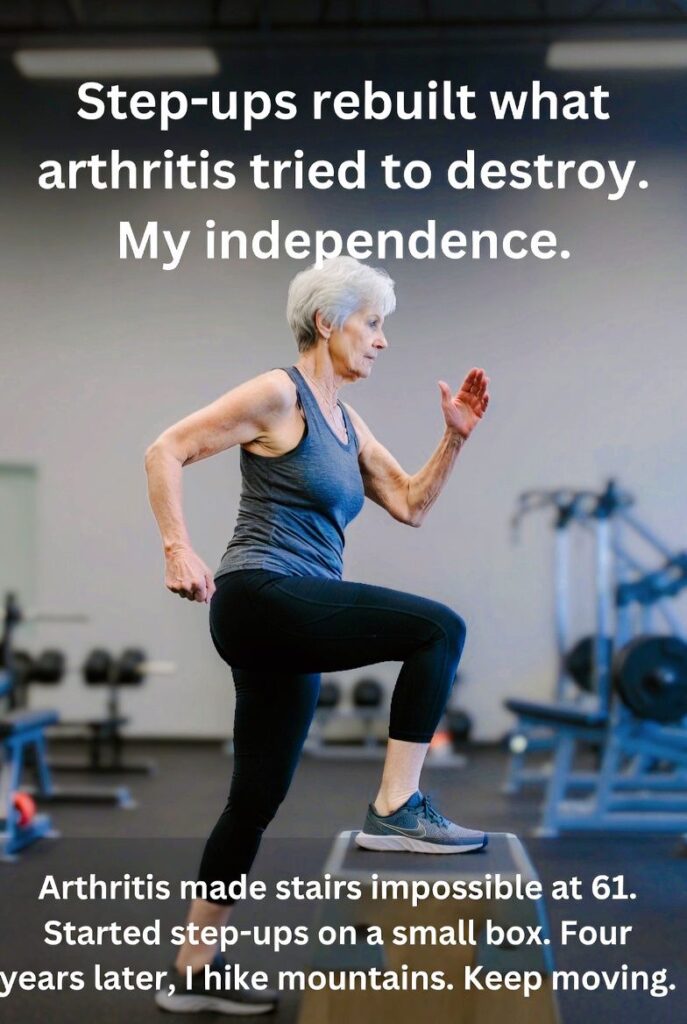
Most people respond to knee pain by avoiding movement. That choice feels protective in the short term, but over the years it often leads to:
-
Weaker muscles
-
Stiffer joints
-
Poor balance
-
Greater fall risk
-
Faster loss of independence
When you train around knee pain intelligently, you’re doing the opposite — you’re building a foundation most people never develop.
💪 What Actually Gets Stronger (Beyond the Knee)
When knee-friendly training is done well, you strengthen far more than the joint itself:
1. Muscle Support Systems
-
Quadriceps, hamstrings, glutes, calves
-
These muscles absorb load before it reaches the knee
-
Strong muscles = less joint stress
2. Connective Tissue Resilience
-
Tendons and ligaments adapt slowly but powerfully
-
Gradual loading improves their tolerance over time
3. Balance and Proprioception
-
Your body learns where it is in space
-
This dramatically reduces fall risk later in life
4. Movement Confidence
-
You stop fearing stairs, uneven ground, getting up from chairs
-
Confidence itself prevents injury
🧠 The Hidden Advantage: Neurological Resilience
Training through manageable discomfort (not injury pain) builds:
-
Better motor control
-
Faster muscle activation
-
More efficient movement patterns
By your 60s, 70s, and beyond, this often means:
-
Quicker reactions
-
Better stability
-
Less hesitation in daily movement
That’s a huge separator between “aging” and aging well.
🧓 Why This Makes You Stronger Than Your Peers Later
Many people reach their later years with:
-
Muscle loss (sarcopenia)
-
Joint stiffness
-
Fear of movement
-
Dependence on support
People who trained intentionally for joint health often have:
-
Strong legs relative to body weight
-
Better walking endurance
-
Easier transitions (sitting, standing, climbing)
-
Greater independence
Not because they trained harder — but because they trained smarter and earlier.
⚠️ The Important Caveat (This Is Critical)
Working out for knee pain only builds resilience if you avoid these mistakes:
❌ Ignoring pain signals
❌ Pushing through sharp or worsening pain
❌ Copying high-impact workouts not built for you
❌ Skipping recovery and mobility
The goal is adaptation, not domination.
Pain that:
-
Is sharp
-
Persists or worsens after workouts
-
Changes your walking pattern
→ needs professional evaluation.
🏆 What “Right” Training Looks Like