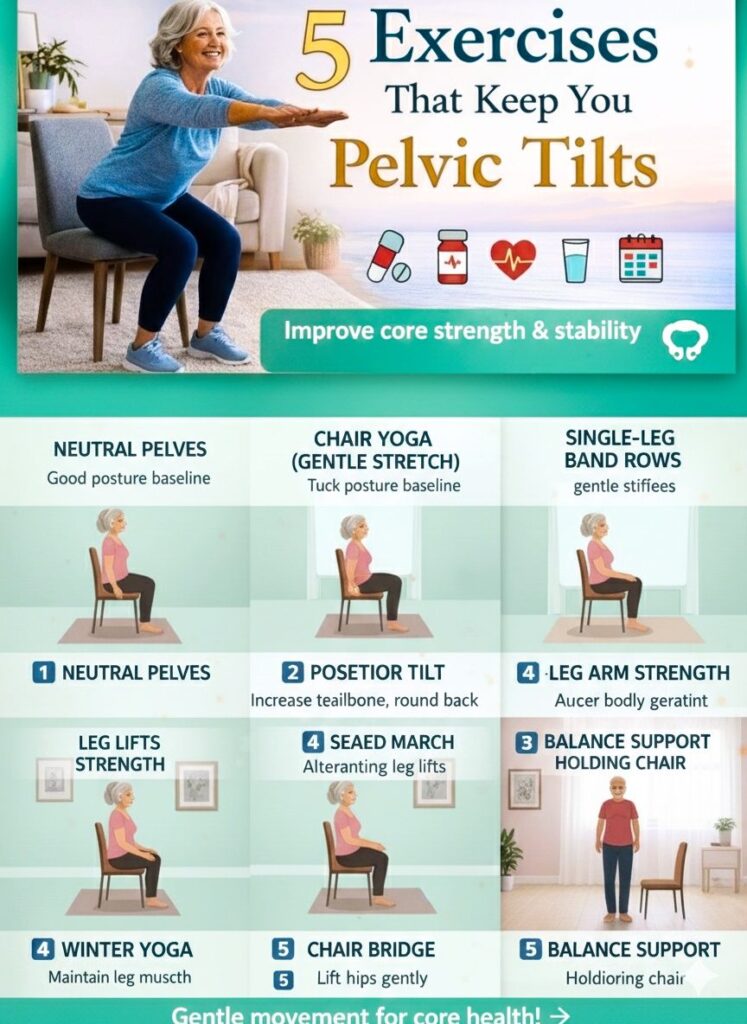
Discover the complete guide to pelvic tilts. Learn how these simple exercises strengthen your core, improve posture, reduce back pain, and boost pelvic and overall health with step-by-step instructions and variations.
📖 Full Article
✅ Introduction: Why Pelvic Tilts Are Essential
In today’s modern world, most of us spend hours sitting at desks, staring at screens, or commuting in cars. Over time, these habits can weaken core muscles, strain the lower back, and even affect your pelvic floor. This can lead to discomfort, poor posture, and reduced mobility.
Pelvic tilts are one of the simplest yet most powerful exercises to counteract these issues. While they look easy at first glance, their benefits are profound: they strengthen the core, stabilize the spine, enhance flexibility, and improve pelvic and overall health.
Whether you’re recovering from injury, aiming to prevent future pain, or simply improving your posture, pelvic tilts empower you to take control of your body and well-being.
💡 Understanding the Science Behind Pelvic Tilts
The pelvic tilt primarily targets the core muscles — including the rectus abdominis, obliques, and transverse abdominis — and engages the lower back, glutes, and hip flexors. By gently moving your pelvis, you:
-
Train spinal alignment, reducing pressure on discs
-
Improve pelvic floor strength, supporting bladder and core stability
-
Increase hip mobility and flexibility, reducing stiffness from sitting
-
Enhance posture, which reduces shoulder, neck, and back tension
For beginners, pelvic tilts may feel subtle. But repeated daily practice strengthens deep core muscles that many people neglect, forming a foundation for all movement.
🏋️♂️ Step-by-Step Guide: Mastering Basic Pelvic Tilts
Step 1: Get Into Position
-
Lie on your back on a comfortable, flat surface.
-
Bend your knees and keep your feet flat on the floor, hip-width apart.
-
Rest your arms by your sides, palms facing down.
Step 2: Engage Your Core
-
Take a deep breath in, then exhale while gently contracting your abdominal muscles.
-
Flatten your lower back against the floor without lifting your buttocks.
Step 3: Tilt Your Pelvis
-
Slowly tilt your pelvis upward, imagining you are pulling your hip bones toward your ribcage.
-
Keep movements slow and controlled.
Step 4: Hold and Release
-
Hold the tilt for 3–5 seconds while maintaining steady breathing.
-
Slowly relax and return to the neutral position.
Step 5: Repetitions
-
Perform 10–15 repetitions, increasing gradually as your core strength improves.
💡 Tips for Beginners
-
Focus on quality, not quantity.
-
Keep movements gentle and deliberate — don’t rush.
-
If your lower back feels strained, reduce the tilt range or place a small pillow under your head for support.
🔥 Variations to Progress Your Pelvic Tilt Practice
-
Bridge Pelvic Tilt
-
Lift your hips slightly off the floor while tilting your pelvis.
-
This engages glutes and hamstrings alongside your core.
-
Standing Pelvic Tilt
-
Stand against a wall with feet shoulder-width apart.
-
Tilt pelvis forward and backward while keeping core engaged.
-
Great for posture and spinal alignment throughout the day.
-
Pelvic Tilt on Exercise Ball
-
Sit on a stability ball and gently rock your pelvis forward and back.
-
Improves balance, deep core engagement, and hip mobility.
-
Knee-Extended Pelvic Tilt
-
Extend one leg at a time while performing tilts.
-
Challenges balance and strengthens obliques and lower abs.
✨ Incorporating Pelvic Tilts Into Daily Life
-
Morning Routine: Perform 5–10 minutes after waking to activate your core and wake up your spine.
-
Desk Breaks: Tilt your pelvis while sitting or standing to counteract long hours of sitting.
-
Pre/Post Workout: Warm up your core before exercise or use as a gentle cool-down.
-
Rehabilitation: Safe for postpartum recovery or lower back pain when done correctly.
Consistency is key. Daily practice strengthens your muscles, improves spinal alignment, and increases mobility over time.
💡 Common Mistakes to Avoid
-
Rushing Through Reps: Pelvic tilts are subtle — speed reduces effectiveness.
-
Arching Your Back: Avoid overextending or lifting your buttocks off the floor.
-
Holding Breath: Focus on controlled breathing — exhale during tilt, inhale when returning.
-
Neglecting Core Engagement: Passive tilts won’t strengthen muscles effectively.
✅ Long-Term Benefits of Pelvic Tilts
-
Stronger Core Muscles: Supports daily movements and prevents injury.
-
Better Posture: Reduces back, neck, and shoulder tension.
-
Reduced Lower Back Pain: Gentle movement relieves pressure on spinal discs.
-
Enhanced Pelvic Floor Health: Supports bladder control and overall stability.
-
Improved Flexibility and Mobility: Easier movement for sports, exercise, and daily life.
-
Greater Body Awareness: Learn how to control your posture and movement consciously.
🌟 Takeaways
Pelvic tilts may seem simple, but their impact on strength, stability, and overall well-being is profound. By committing just a few minutes a day:
-
Strengthen your core
-
Reduce back and hip discomfort
-
Improve posture and mobility
-
Gain confidence in your physical health
This is a low-impact, high-reward exercise that anyone can start today, regardless of age or fitness level.